
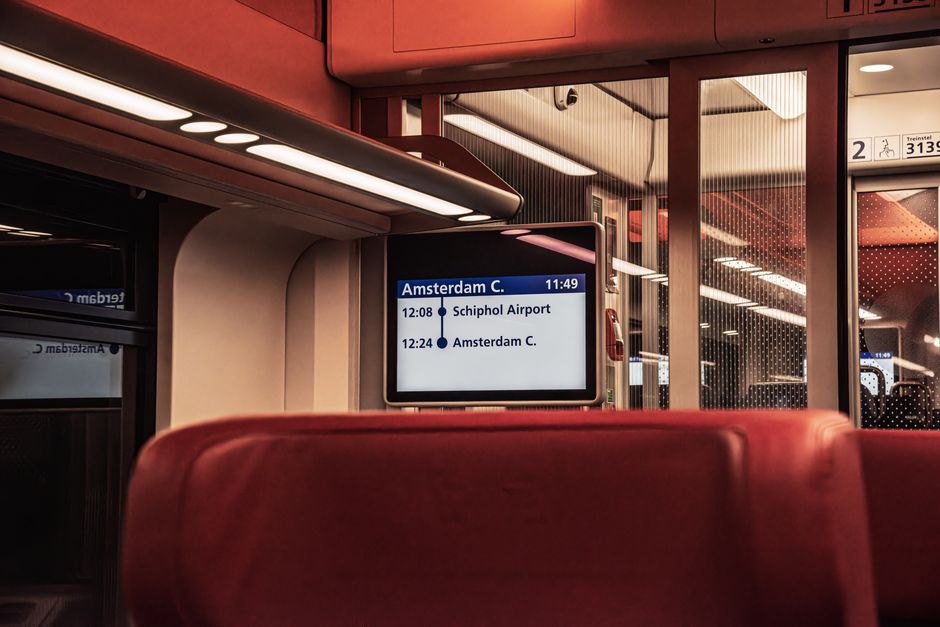
Getting from Amsterdam Schiphol Airport to the city centre with luggage is one of those questions where “fastest” depends on what time you land and how many people you’re travelling with. In general: take the train for the quickest, most reliable ride, then use a short tram/walk from the station.
If you’re landing late, have kids in tow, or you just want the least hassle door-to-door, a taxi is often the smoothest choice—especially when trams and crowds make luggage feel like a sport. Buses can work, but they’re usually slower and more crowded.
Below, we’ll help you pick the best option by time of day, and we’ll also show you exactly where it’s easiest to roll your suitcase through the city.
Fastest option by time of day (Train vs Taxi vs Bus)

Choose train if you want predictability: you’ll spend less time “waiting to see” and more time actually moving.
Midday & off-peak
For mid-day and quieter times, you still can’t go wrong with the train. It’s typically the simplest route to the main hubs, and the stations have lifts and escalators so you’re not wrestling stairs.
If you’re travelling with a lot of luggage and you’re heading to a hotel far from the station, taxi can still be worth it for the comfort—even if it’s not always faster.
Late night / early morning
After midnight, options can tighten. The train can still be a good call if it runs for your timing, but if you arrive when services feel less frequent—or you’re tired and want a stress-free exit—taxi becomes the easiest “always works” fallback.
Bus can be fine early/late if your exact route is convenient, but with luggage it’s often the least comfortable: more stops, more people, and more chances you’ll be standing with bags.
Choose your landing spot in the city (with rolling luggage)

1. Amsterdam Centraal (best for most classic city-centre stays)
If your hotel is around the Dam area, the canal belt, or most of the “first time in Amsterdam” sights, Amsterdam Centraal is usually the cleanest landing point.
Rolling luggage here is usually easiest when you stick to the main pedestrian routes and avoid narrow side streets. If you’re going to the canal belt, plan a straight, well-lit path first—then switch to shorter walks for the last few turns.
Good to know: keep your wheels on the wider routes and save the cobblestones for when your bag is down to “light mode.”
2. Amsterdam Zuid (best for Museumplein area and the south side)
If you’re heading toward the museum area, the business district, or anywhere closer to the south side, Amsterdam Zuid is often the most convenient station.
From here, you’ll typically need less “across-city walking” with a suitcase. Even if you still walk for 5–15 minutes, you’ll usually feel less pressure to drag luggage over awkward stretches.
Good to know: Amsterdam Zuid is a great choice when you want to pair train + a short local ride or quick walk to reduce wheel friction.
3. De Pijp / RAI area (best if your hotel is near the southern neighbourhood vibe)
If your accommodation is around De Pijp or nearer to the RAI area, landing closer to the south saves you time and energy.
Rolling luggage is manageable as long as you choose your final path carefully—stay on wider streets and main junctions, and don’t cut through small alley-like streets just because they look shorter.
Good to know: if the last stretch looks charming but narrow, it’s often better to take a short tram/metro segment rather than “wheel-through.”
4. The Canal Belt edge (best when you want to walk, not transit)
If your hotel is near the canal belt edge—close to the big walking corridors that connect to the main stations—this can be a “walk-only” option from your landing spot.
It works best when you can keep your luggage mostly on straight routes with fewer turns. If your hotel is tucked deep inside tiny streets, wheels become annoying fast, and you may prefer a taxi for the final door-to-door stretch.
Good to know: if your hotel entrance is on a narrow lane, ask in advance whether there’s a step-free path for luggage.
Train from Schiphol with luggage (step-by-step)

The biggest luggage-related trick is not boarding—it's orientation. Schiphol stations can feel like a maze when you’re tired. Before you roll, check the signs for your exact destination station, and only then move toward the platform.
Getting your luggage through (elevators, lifts, and moving walkways)
Trains in the Netherlands are designed for travellers, including those with big bags. Still, take a minute to locate lifts/escalators so you don’t end up on stair-only routes.
When you board, try to find a spot near doors or areas that feel easier for wheel movement. If the carriage is crowded, politely keep your suitcase in a space that doesn’t block movement.
Good to know: aim to board a carriage that feels like it has smoother floor access for your wheels—door zones are often easier than middle aisles.
Best for families (less waiting, more control)
Families usually find the train best because it’s predictable and you don’t fight traffic. You can also control the rhythm: a planned snack stop, a quick toilet break before boarding, and then a straightforward ride.
If you’re travelling with toddlers or strollers, be mindful of peak crowding. When possible, choose a train slightly before or after the busiest commuter departures.
Good to know: when the station is packed, it can be worth waiting for the next train rather than squeezing with a stroller and rolling bags.
Taxi or private transfer (when it’s worth it)
If you’re travelling with more bags (or you’re worried about stairs), taxi is one of the few options that treats your whole journey as one continuous trip.
Good to know: if you can, have your hotel address ready as text—Amsterdam streets can be easier to navigate with a clear destination.
Luggage-friendly route tips
A taxi is easiest when your destination is within reach of the centre but not necessarily “right next to a station.” It also helps if you’re dealing with cobblestones, bridges, or narrow entrances at your hotel.
When booking or communicating your destination, mention if you need an approach with minimal steps (especially if you have a stroller or a hard-to-manoeuvre suitcase).
Good to know: ask for a drop-off at a main entrance. Amsterdam’s best locations are charming, but some are not the easiest for wheels.
Traffic reality (why “fastest” can change)
In calm traffic, a taxi can feel almost as direct as a train—especially if you land outside commuter peaks. In rush hours, taxi time can stretch.
So the practical rule: if you land when trains are frequent and you’re heading near a station, train is usually the smart default. If you land late, arrive tired, or need door-to-door for family comfort, taxi often balances out the time.
Good to know: if you’re arriving during a busy window and you’re not near the station, take the taxi—don’t “hope” the drive will be quick.
Bus & night options (slower, but okay)
When buses make sense
Buses can work when your accommodation is along a convenient bus corridor, or when you’re travelling light and want a lower-cost option. The bus can also be useful as a supplement if train timing doesn’t match your arrival.
With luggage, the main trade-offs are crowding and longer travel time due to stops. You’ll spend more time managing your bag through doors and around other passengers.
Good to know: if you have heavy luggage, choose a seat position where you can keep the suitcase at your feet or between your legs—standing with wheels is exhausting.
For Schiphol to central areas
Buses typically connect Schiphol to several major neighbourhoods, including options closer to popular city areas. The exact route you choose matters more than the mode itself—pick the bus that reduces your final walk.
If your hotel is not near a bus stop, you’ll still need a final stretch. That’s where rolling luggage becomes the deciding factor.
Good to know: compare the “bus + 15 minutes of wheel dragging” against “train + 5 minutes of smarter walking.” The second usually feels easier.
If you’re travelling late
Late-night travel can mean fewer options or different patterns. Buses can still be available, but they’re often less predictable with crowds.
If you’re travelling with children, or if you have multiple bags, taxi is usually the calmer bet late at night.
Good to know: if you’re unsure, don’t gamble with luggage—late arrivals are when a taxi saves the most stress.
Final tips
- Pick your station first, then your transport: Amsterdam Centraal and Amsterdam Zuid are the two easiest anchors for luggage-friendly movement.
- For rolling suitcases, prioritise wider routes and step-free paths. Amsterdam’s charm includes cobbles and narrow lanes—avoid those with wheels when you can.
- For families: train for predictability, taxi for comfort. If your arrival time is late or your hotel is tricky to reach with wheels, taxi is often the least hassle.
- If you’re not sure which option fits your exact destination, choose the one that minimises your final walking distance from the drop-off point to your door.